Building a human digital twin for risk prediction of hospital-acquired infections at the Royal Hospital for Neuro-disability in London
Background
The Royal Hospital for Neuro-disability (RHN) is a specialist hospital experienced in working with people with a range of neurological conditions and brain injury in London, UK. Patients contracting a hospital-acquired infection (HAI) at RHN often require transfer to St George’s Hospital for acute treatment. These unplanned transfers to an acute setting are extremely costly, not to mention the considerable impact they have on patients’ functional recovery trajectories. These transfers also add pressure on ICBs through high cost and impact on patient flow adding pressure to the system.
Sanome has developed an AI-enabled clinical decision support tools that helps clinicians understand emerging health issues in patients, such as the likelihood of developing a hospital-acquired infection. Their first product MEMORI is integrated within the hospital’s electronic patient record (EPR) system (PatientSource) and supports clinical teams with prioritising patients, recommended next actions and explanation for the patient’s risk level.
This case study provides a summary of the collaboration by the RHN, Sanome and PatientSource from 2023 to 2025, from understanding clinical needs, co-designing the first version of MEMORI, gaining ethical approval for a research database to enable joint research and development, to achieving certification as a fully regulated Software as a Medical Device (SaMD).
Studies have shown that 30-55% of HAI are preventable. This was the key hypothesis the Sanome and RHN teams started with. The first step was understanding clinical workflows and requirements of the clinical teams, and how Sanome could support these. The collaboration is not over at the time of writing, and the first deployment of MEMORI in a clinical setting is soon to be started across the RHN.
Co-design and data access
Data access & EPR integration
To develop and evaluate the AI model powering MEMORI, the Sanome data science and machine learning team needed access to patient data. Sanome, RHN and PatientSource worked together to gain ethical approval and set up data management to ensure patient data would remain secure and appropriately handled at all times.
PatientSource is a cloud-based EPR used by the RHN since 2019. Following ethical approval, the engineering teams at Sanome and PatientSource, informed by the co-design described below, collaborated to integrate MEMORI directly into the PatientSource interface used by clinical teams at RHN. This integration means the clinical teams see patients’ MEMORI risk levels right alongside all other medical details without having to implement new workflows.
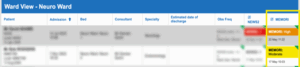
MEMORI risk level embedded within the ward overview, next to NEWS2
Working with the clinical teams
The RHN and Sanome teams worked together over several months to understand the needs of the various clinical specialties and patients at the hospital and develop the MEMORI product together.
Several ideation workshops with clinical staff (doctors and nurses), the research team and non-clinical staff (finance, operations, IT) helped map the needs at the hospital and collect ideas for problems to solve. Apart from infections, the range of needs included various physical, infection control and organisational outcome capabilities, including falls, pressure sores and improving patient flow. From these ideation workshops, hospital-acquired infections became the focus of the first MEMORI product to be developed due to high impact on patient outcomes and cost to the ICB.
Throughout the development of MEMORI, Sanome continued to engage the staff in the process through regular feedback and usability sessions. These sessions were incredibly valuable for the team developing MEMORI, from understanding how patient data input works in the daily life of the hospital to clinical infection pathways and directly contributing to the design of both MEMORI the AI model and the user-facing elements. PatientSource, the EPR provider, was a key partner through all of this as MEMORI is embedded directly to the EPR alongside all other medical details of each patient. Throughout the process, over 50 RHN staff members across teams and disciplines helped co-design MEMORI.
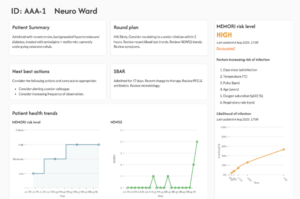
MEMORI Explainability Dashboard
Road to live-deployment
Following months of close co-design with clinical teams and rigorous technical validation, we achieved a major milestone: in June 2025, MEMORI received Class IIb certification under the EU Medical Device Regulation. This approval enables MEMORI to be rolled out across the RHN as a certified medical device, allowing its integration into the current standard of care.
The next phase is crucial; evaluating MEMORI in a real-world clinical setting. This post-market evidence will be foundational in several ways: it ensures we meet our ongoing regulatory obligations; it helps us understand and optimise clinician adoption and usability; and it will generate the clinical and operational insights needed to support future health technology assessments and procurement decisions by healthcare systems.